

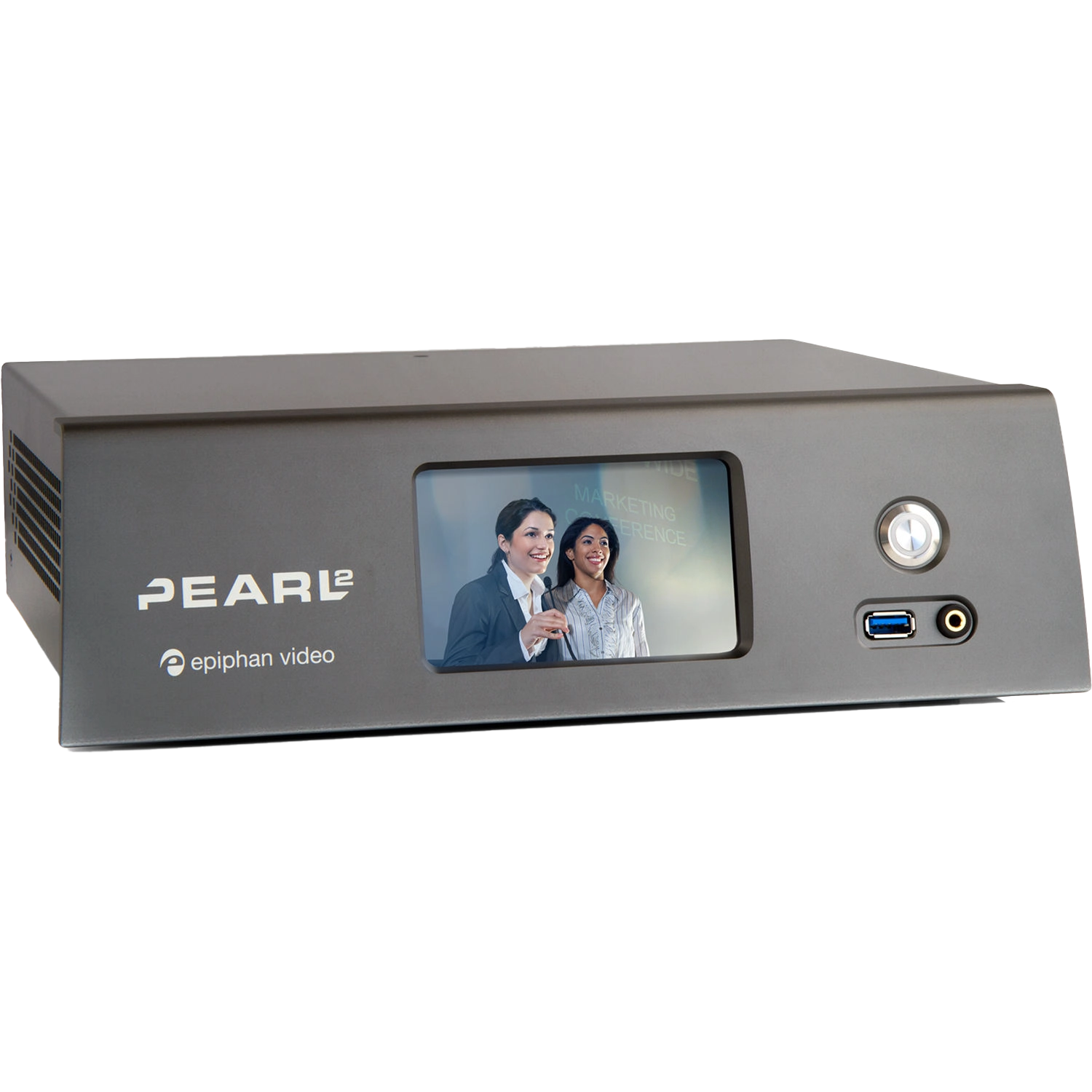
The Epiphan Pearl-2 is a powerful portable all-in-one live video production system that combines switching, encoding, recording, and multi-platform streaming for up to six video sources in a compact desktop unit built for professional live events and productions.
6-Channel Video Inputs and Connectivity
The Pearl-2 accepts 2 12G-SDI inputs via BNC, 4 HDMI inputs, and 3 USB 3.0 inputs on the rear panel, along with network video sources including NDI, NDI|HX, RTSP, and SRT, allowing broadcast cameras, laptops, UVC webcams, and IP-connected cameras to all run simultaneously as sources.
4K Recording and Encoding
Powered by a 6th generation Intel i7 processor, the Pearl-2 captures 4K video at 30fps with hardware-accelerated H.264, MJPEG, and NDI encoding across multiple programs simultaneously. All recordings are saved to a built-in 512GB SSD, with automatic file transfer to a local USB drive or networked storage for secure backup and post-event handoffs.
Two 4K HDMI Outputs and Custom Layouts
Two 4K HDMI outputs can feed confidence monitors, front-of-house displays, or broadcast monitors simultaneously. The web-based Admin panel includes a drag-and-drop layout designer for building custom picture-in-picture compositions and image overlays, with changes reflected immediately in the live stream and on connected displays.
Multi-Platform Streaming
The Pearl-2 streams simultaneously to YouTube, Facebook, and any CDN or video portal over a single Gigabit Ethernet RJ45 connection, with support for RTMP, RTSP, HLS, SRT, HTTP, FLV, ASF, UPnP, and SAP protocols. A built-in streaming server supports local unicast and multicast streaming to up to 50 viewers on the same network without an internet connection.
Audio I/O and Control
Audio inputs include 2 balanced 6.3mm TRS jacks, a stereo RCA line input, and 3 USB 3.0 ports for USB audio sources, with a 3.5mm headphone output for monitoring. Control is available via the onboard touchscreen LCD, the Epiphan Live web portal from any phone or tablet, the web-based Admin panel, RS-232, or HTTP APIs, with Crestron and QSys driver support for managed AV environments.